Most landing page advice focuses on aesthetics — colour choices, font sizes, button shapes. These things matter, but they're not what move conversion rate significantly. The changes that actually double conversions are structural: what you say, where you say it, and how you reduce friction.
Here are the five we come back to on almost every project, with specific implementation detail so you can apply them today.
What Is a Good Landing Page Conversion Rate?
Before diving in, it's worth anchoring on realistic numbers. Average landing page conversion rates across industries sit between 2–5%. A well-optimised landing page for a high-intent audience typically converts at 8–12%. If you're running paid traffic and converting at below 2%, something structural is wrong.
The improvements below target structural problems — not marginal tweaks. Each one has the potential to move conversion rate by 30–100% on its own.
1. Lead With the Outcome, Not the Feature
The most common mistake on landing pages: leading with what you do instead of what the visitor gets.
Wrong: "We offer professional web design services with a team of experienced developers."
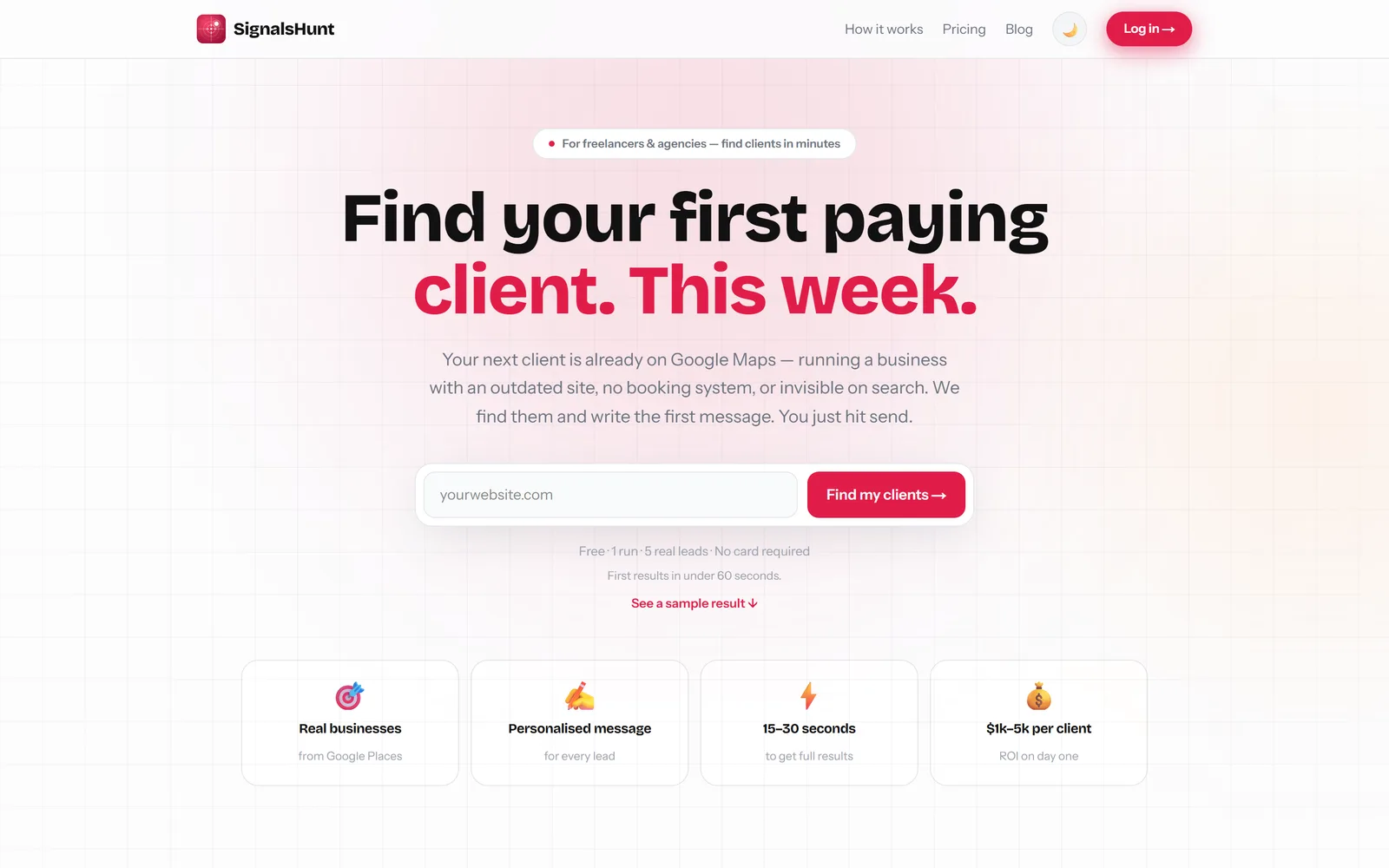
Right: "Get a website that ranks on Google and turns visitors into customers — in under 2 weeks."
Visitors don't care about your process. They care about their outcome. Your headline should state the specific result they'll achieve. Your subheadline can explain how.
This is sometimes called the "so what" test. Take your current headline and ask "so what?" If you can answer it with something more valuable, rewrite the headline with that answer.
For example: "Expert web designers with 10 years of experience." So what? "So your site will be built correctly." So what? "So it will rank on Google and bring in customers." — that's your headline.
A simple reframe of the hero headline is often the single highest-impact change we make. We've seen conversion rate improvements of 40–60% from this alone, across industries from SaaS to professional services to local businesses.
The subheadline should do two things: (1) clarify how you deliver the outcome, and (2) introduce a specific differentiator. "Built on Next.js, delivered in 3–7 days, with SEO included from the first line of code" is more effective than "We build beautiful websites."
2. Remove the Navigation
Landing pages and navigation menus are a bad combination. Every link in your navigation is an exit from your conversion funnel. If a visitor clicks "About" and reads for 5 minutes before leaving, your landing page didn't fail — your navigation let them escape.
On pages built specifically to convert — whether for an ad campaign, a product launch, or a service enquiry — remove the main navigation entirely. Keep the logo (linking to the homepage is fine) and a single CTA button in the header. That's it.
This is counterintuitive, but the data is consistent: removing navigation from landing pages increases conversion rate in the majority of A/B tests. The classic Unbounce study found an average conversion rate lift of 16% from removing navigation — and in some industries, the lift is significantly higher.
What about visitors who want to explore? If you're running paid traffic to a specific offer, you want commitment, not exploration. Visitors who want to learn more should do so by scrolling, not by navigating away. Your landing page should anticipate and answer every question a visitor might have — which removes the need for navigation.
3. Put Social Proof Above the Fold
Testimonials placed at the bottom of a page are nearly invisible. Most visitors don't scroll that far, and the ones who do have already made their decision.
The most effective placement is directly in the hero section or immediately below it — before the visitor has decided whether to trust you. A single strong quote with a name, photo, and specific result is more persuasive than ten generic "5 stars, great service!" reviews placed at the bottom.
What makes a testimonial effective?
- Specificity: "Our organic traffic went from 200 to 4,200 monthly visits in six months" is far more powerful than "great results."
- Credibility signals: Name, job title, company, and a real photo. Anonymous testimonials are ignored.
- Objection handling: The best testimonials address the primary objection directly. If cost is the barrier, find a testimonial that addresses it: "I was hesitant about the investment, but we recovered the cost within the first month."
- Outcome clarity: The testimonial should describe the situation before, what happened, and the result after.
For products or services where video testimonials are feasible, they consistently outperform text. A 60-second video review placed in the hero section can increase conversion rate by 30–80% compared to a text quote.
4. Make the CTA Specific
"Submit" and "Get started" are invisible buttons. They tell the visitor nothing about what happens next, and they generate anxiety about what they're committing to.
Specific CTAs dramatically outperform generic ones:
- "Get my free audit" beats "Submit"
- "See the pricing" beats "Learn more"
- "Book a 30-minute call" beats "Contact us"
- "Download the guide" beats "Get access"
- "Start my free trial" beats "Sign up"
The more specific the CTA, the more it sets accurate expectations, and the lower the psychological barrier to clicking. Visitors convert when they know exactly what they're signing up for.
There are three elements to a high-converting CTA button:
- Copy: First-person, action-oriented, specific to the offer ("Get my free report" not "Get your free report" — yes, this makes a measurable difference).
- Colour: High contrast with the surrounding design. Your CTA button should be impossible to miss.
- Placement: Visible without scrolling, repeated at each natural decision point in the page, and immediately following any section that builds trust (a testimonial, a case study, a results section).
Reduce secondary CTAs. Having five buttons on a page that all say different things dilutes the primary conversion action. Pick one primary CTA and one secondary (for visitors who aren't ready to commit — "learn more" or "see how it works").
5. Address the Primary Objection Directly
Every offer has a primary objection — the single most common reason people don't convert. On a paid service, it's usually cost. On a free offer, it's usually privacy ("what will you do with my details?") or time ("how long will this take?").
The mistake is ignoring objections and hoping visitors just push through them. The better approach: name the objection directly and answer it, immediately adjacent to your CTA.
Common objections and how to handle them:
"This seems expensive" → Add a price anchor ("from £X") and a value frame ("the average client sees £X in new business within 90 days").
"I don't know if this will work for me" → Add a specific use-case qualifier ("designed for UK businesses with an existing website and 0–500 monthly visitors").
"I don't want to commit to anything" → Add a no-commitment statement next to your CTA ("No contracts. No setup fees. Cancel any time.").
"What happens after I click?" → Add a micro-copy line below the button explaining the next step: "You'll receive a report within 24 hours. No calls, no pressure."
Naming the objection builds trust. It signals that you understand your customers, and that you have nothing to hide. The instinct to avoid naming objections — because you don't want to give people a reason not to buy — is precisely backwards. People already have the objection in their head. Naming it and answering it removes it.
How These Changes Work Together
These five elements work as a system. A headline that leads with outcomes sets up the right expectation. Removing navigation keeps the visitor in the funnel. Social proof above the fold builds trust before they've invested much time. A specific CTA removes commitment anxiety. And addressing objections removes the last barrier.
When all five are in place, conversion rate improvement is typically in the 80–150% range over a baseline page that gets none of them right.
The order of implementation matters too. Fix the headline first — it's the highest-impact change with the lowest effort. Then remove navigation. Then reposition social proof. CTA and objection handling are typically intertwined, so do them together.
If your current landing page doesn't address all five, there's untapped conversion rate sitting there waiting. Keep in mind that conversion rate isn't the only lever — a page that converts well but doesn't rank still brings no traffic. Read why most websites don't rank on Google to make sure both sides are covered.
If you want a review of your landing page alongside your technical SEO, our free audit covers both — and you'll have a full report within 24 hours.